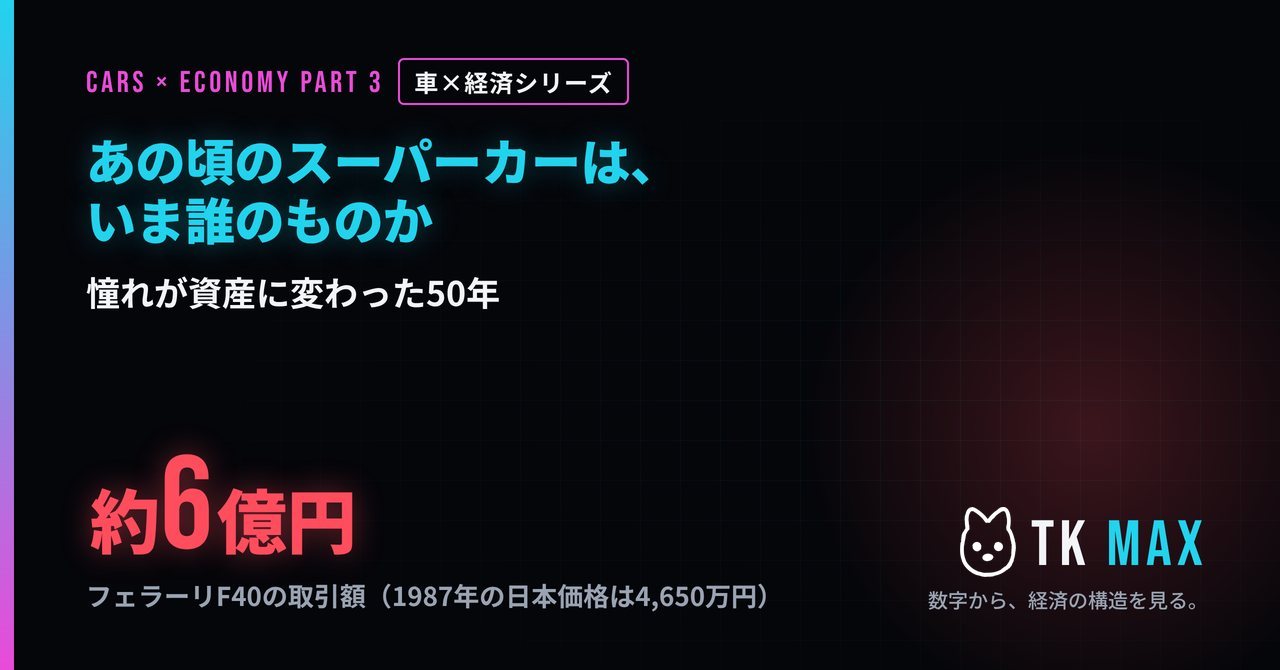
あの頃のスーパーカーは、いま誰のものかWho Owns the Supercars of Our Childhood Now?―― 憧れが資産に変わった50年— Fifty years of dreams turning into assets
✨ 公開データをもとに、独立した立場で分析しています。✨ Independent analysis built on public data.☕ 応援するSupport
💡 なぜ作ったか:作者は小学生のころにスーパーカーブームの真っただ中にいて、社会に出てからはF1ブームを見てきました。フェラーリもランボルギーニも、買えないけれど憧れ続けた車です。その憧れの車が、いまは何億円という値段で取引されています。子どもの頃に見上げた車の値札が、なぜここまで変わったのかを、クルマ編・バイク編に続いて数字で確かめたくて作りました。💡 Why this dashboard: The author was in elementary school at the height of Japan's supercar boom and, as a young adult, watched the F1 boom. Ferraris and Lamborghinis were cars to admire, never to buy. Today those same cars change hands for hundreds of millions of yen. Following the car and motorcycle editions, I built this to check with numbers why the price tags we looked up at as children changed so much.
In the late 1970s, Japanese children chased supercars through the streets with cameras. A Countach LP400 cost ¥19 million in Japan — about 17 years of a new graduate's starting pay (~¥94,000 a month). Fifty years on, Countaches trade for ¥100–380 million, and the Ferrari F40, sold for ¥46.5 million in 1987, is worth about ¥600 million at today's exchange rate. But not every dream appreciated. The Testarossa now sells below its original price even in nominal yen, and the Porsche 930 Turbo and Ferrari BB have barely kept pace with wages. The supercar boom, the bubble and F1, the strong yen and the weak yen, and Ferrari's business of never making enough: this page follows, in order, what moved the price tags on the cars we dreamed of.
4,650万→約6億円¥46.5M→~¥600M
フェラーリF40(1987年の日本価格→2025年の取引額を1ドル158円で換算)Ferrari F40 (1987 Japan price → 2025 trades at ¥158/$)
1,330万ドル$13.3M
1989年11月、日本人が買った250GTO。クラシックカー市場の頂点The 250 GTO bought by a Japanese collector in Nov 1989 — the market's peak
2,580万→約2,400万円¥25.8M→~¥24M
テスタロッサ(1984年の日本価格→いまの相場)。名目でも新車割れTestarossa (1984 Japan price → today). Below its new price even in nominal terms
13,640台13,640
フェラーリの年間出荷台数(2025年)。それでも営業利益率は29.5%Ferrari's annual shipments (2025) — with a 29.5% operating margin
約2.8倍~2.8×
大卒初任給の伸び(1976年9.43万円→2025年26.23万円)。値上がりを測る物差しGrowth in graduate starting pay (¥94,300 in 1976 → ¥262,300 in 2025) — the yardstick for "real" gains
📄=企業の決算発表、官公庁の統計、オークション会社の公表結果、複数の報道で確認された事実。📊=数字の組み合わせから読み取れる関係(因果の断定ではない)。💬=ディーラーなど当事者の証言や、立場で評価が分かれる解釈。🧮=試算のために本ページが置いた仮定。スーパーカーの相場は1台ごとの状態・来歴・走行距離で大きく変わり、ここで使う数字は「その車種の目安」です。円換算は特に断りがない限り1ドル158円(2026年10月17日の東京市場の水準)で計算しています。📄 = company results, government statistics, auction-house results, or facts confirmed by multiple reports. 📊 = relationships read from combined figures (not causal claims). 💬 = testimony from dealers and other participants, or interpretations that differ by viewpoint. 🧮 = assumptions this page makes for its estimates. Supercar values vary enormously with condition, history and mileage; the figures here are benchmarks for each model. Unless noted, yen conversions use ¥158 per dollar (Tokyo market level on 17 Oct 2026).
OVERVIEW上がったのは一握り。そして、持ち主は入れ替わったOnly a few soared — and the owners changed
The car edition traced how Japanese tuner cars, and the motorcycle edition how classic bikes, came to cost "more than new" through overseas demand and the weak yen. Supercars sit at the very front of that trend. But they were cars almost no one in Japan could afford in the first place, and the reasons for their rise are more tangled: memories of the boom, bubble speculation, makers rationing production, and where the world's wealthy park their money.
📈 給料の伸びを大きく超えた車📈 Cars that far outran wages
ミウラ:日本価格1,200万円 → 約3億円(P400S、2025年落札)📄Miura: ¥12M in Japan → ~¥310M (P400S, 2025 sale) 📄
この間に大卒初任給は約2.8倍。上の3台は、ほぼ横ばいか目減りです 📊Graduate pay rose ~2.8× meanwhile, so these three are flat or down in real terms 📊
このページの読み方How to read this page
02:スーパーカーブーム02: The supercar boom
子どもたちが追いかけた車は、当時いくらで、初任給の何年分だったのか。What the cars children chased cost then, measured in years of starting pay.
03:バブルとF103: The bubble and F1
円高とバブルで日本が世界の名車を買い、崩壊で手放した。同じころ、日本はF1に熱狂した。With the strong yen and the bubble, Japan bought the world's great cars — then sold them when it burst. Meanwhile, Japan went wild for F1.
04〜05:資産になった憧れと、円の物差し04–05: Dreams as assets, measured in yen
何が上がり、何が上がらなかったか。フェラーリの商売の仕組みと、為替だけで変わる円の値札。What rose and what didn't; how Ferrari's business works; and how the yen price moves with the exchange rate alone.
06〜07:自分で試算する、そしてゆくえ06–07: Run the numbers, and what's next
「あの年に買っていたら」を、維持費込みで試算。そして後編・ガレージ編への橋渡し。"If I had bought one that year" — estimated with upkeep. Then a bridge to the next part, the Garage edition.
THE SUPERCAR BOOM1970年代後半、子どもたちが追いかけた値札The price tags children chased in the late 1970s
One trigger of the supercar boom was the manga Circuit no Ookami ("Circuit Wolf"), serialised in a boys' weekly in the mid-1970s. With the hero's Lotus Europa, plus Countaches and Ferraris appearing week after week, children collected erasers and cards and photographed the real cars at shows and on street corners. 📄 Yet only a handful of Japanese could actually buy one.
ブームのころの日本での価格と、初任給で見た重さ 📄Japanese prices during the boom, measured against starting pay 📄
車種Model
当時の日本価格Japan price then
大卒初任給の何年分(1976年・月9.43万円)Years of graduate pay (1976: ¥94,300/month)
Lamborghini Countach LP400
1,900万円¥19.0M
約16.8年~16.8 yrs
Ferrari 365GT4/BB
1,850万円¥18.5M
約16.3年~16.3 yrs
Porsche 911 Turbo(930)
1,500万円¥15.0M
約13.3年~13.3 yrs
Lamborghini Miura P400
1,200万円¥12.0M
約10.6年~10.6 yrs
Lancia Stratos
約1,000万円~¥10.0M
約8.8年~8.8 yrs
Porsche 911 Carrera RS 2.7
780万円¥7.8M
約6.9年~6.9 yrs
Lotus Europa
315万円¥3.15M
約2.8年~2.8 yrs
価格は「スーパーカーブームのころ」の日本での価格として報じられたもの(WEB CARTOP)。初任給は厚生労働省「賃金構造基本統計調査」の1976年の大卒初任給。「何年分」は初任給×12か月で割った本ページの計算です(賞与・昇給は含まない)。🧮 同じ記事は、1970年ごろの1,000万円は、いまの3,500万〜4,000万円に相当するとしています。Prices as reported for Japan "around the supercar boom" (WEB CARTOP). Starting pay is the 1976 university-graduate figure from the Ministry of Health, Labour and Welfare wage survey. "Years" divides by 12 months of starting pay — this page's calculation, excluding bonuses and raises. 🧮 The same article says ¥10 million around 1970 is worth roughly ¥35–40 million today.
スーパーカー1台=初任給の何年分か(1976年基準)One supercar = how many years of starting pay (1976 basis)
なぜ、子どもたちの車だったのかWhy they were children's cars
買えないから、夢になった 💬Unaffordable, so they became dreams 💬
ローンもほとんど使えず、1,000万円単位の現金が必要だったとされる時代。持ち主は医師や会社経営者などに限られ、子どもにとっては「見るもの」「集めるもの」でした。It was reportedly an era when loans were rarely available and buyers needed cash in units of ¥10 million. Owners were limited to doctors, business owners and the like; for children, the cars were things to see and collect.
50年後、その子どもたちが買い手の世代に 📊Fifty years on, those children are the buyers' generation 📊
ブームの子どもたちは、いま50代後半〜60代。世界でも、自分が若い頃に憧れた車を買うのが旧車市場の典型的な動き方と言われます。カウンタックやBBの値段には、この「記憶の需要」が乗っています。The boom's children are now in their late 50s and 60s. Worldwide, buying the car you dreamed of when young is said to be how the classic market typically works. The price of a Countach or BB carries this "demand from memory."
THE BUBBLE & F1円高とバブルで日本が買い、崩壊で手放したJapan bought with the strong yen and the bubble — and sold when it burst
By the time the boom's children entered the workforce, Japan was heading into the bubble economy. After the 1985 Plaza Accord the yen soared, making foreign classics cheap in dollar terms. On the back of easy money and soaring land and stock prices, Japanese buyers became major players in the world's classic-Ferrari market. 📄 At the same time, Japan went wild for Formula 1.
1985.9
プラザ合意。年平均で1ドル約239円(1985年)だった円は、1987年には約145円に。📄Plaza Accord. The yen, averaging ~¥239 per dollar in 1985, averaged ~¥145 by 1987. 📄
1987.4
フジテレビがF1の全戦中継を開始。中嶋悟が日本人初のフル参戦ドライバーとしてデビュー(ロータス・ホンダ)。深夜放送でも視聴率は伸びたとされる。📄Fuji TV begins broadcasting every F1 race. Satoru Nakajima debuts as Japan's first full-time F1 driver (Lotus-Honda). Ratings reportedly grew despite the late-night slot. 📄
1987
フェラーリ創業40周年のF40が登場。日本での価格は4,650万円。📄 11月には鈴鹿で初の日本GPが開かれ、フェラーリが優勝。📄Ferrari's 40th-anniversary F40 is unveiled, priced at ¥46.5M in Japan. 📄 In November, Suzuka hosts its first Japanese GP — won by Ferrari. 📄
1988
マクラーレン・ホンダが16戦15勝。8月には創業者エンツォ・フェラーリが死去し、「エンツォ最後のフェラーリ」となったF40の人気はさらに過熱。📄McLaren-Honda wins 15 of 16 races. In August founder Enzo Ferrari dies, and demand for the F40 — "the last Ferrari Enzo approved" — overheats further. 📄
1989.11
日本人コレクターがフェラーリ250GTOを1,330万ドル(+手数料)で購入。売った米国のディーラーは、これを「市場の頂点」だったと振り返る。同じ年、日本人の手に渡った275GTB/4は96.5万〜100万ドル、288GTOは87.5万ドル。💬A Japanese collector buys a Ferrari 250 GTO for $13.3M plus commission. The US dealer who sold it later called it "the peak of the market." The same year, 275 GTB/4s went to Japanese buyers for $965k–$1M and 288 GTOs for $875k. 💬
1989–90
F40は「走る不動産」と呼ばれ、日本での取引価格は最大2億5,000万円に達したとされる。📄 米国のディーラーは、日本の銀行が不動産の評価額の100〜125%まで融資していたと証言する。💬The F40 is dubbed "real estate on wheels," reportedly trading for up to ¥250M in Japan. 📄 A US dealer testifies that Japanese banks lent 100–125% of property appraisals. 💬
1990–92
日銀の利上げで日本のバブルが崩壊。クラシック・フェラーリの相場は、取引例で5〜7割下がった。1991年1月に17.5万ドルだった365GTC/4の買値は、同じ年の12月に7.5万ドルに。著名な日本人コレクターは投げ売りを迫られた。💬The Bank of Japan's rate hikes burst the bubble. Classic-Ferrari prices fell 50–70% in example deals; an offer of $175k for a 365 GTC/4 in January 1991 dropped to $75k by December. Prominent Japanese collectors were forced to dump cars. 💬
1994–97
名車が日本から流れ出す。1,330万ドルの250GTOは約350万ドルで米国人の手に。2台の275GTB/4は約25万ドルずつで米国へ戻った。💬The great cars flow out of Japan. The $13.3M 250 GTO went to an American for about $3.5M; two 275 GTB/4s returned to the US for about $250k each. 💬
教訓:「熱狂」が「投機」に置き換わったとき 💬The lesson: when enthusiasm is replaced by speculation 💬
米国の保険・評価会社Hagertyは、80年代のフェラーリ・バブルを振り返る記事で、市場が「実際に乗る人」を使い果たしたこと、借金で買われた車が値下がりで一斉に売りに出たことを崩壊の理由に挙げています。いまの買い手は現金で買う人が多く、同じ投げ売りは起きにくいという見方と、「今回は違う」という言葉こそ危ないという見方の両方が紹介されています。Looking back on the 1980s Ferrari bubble, US insurer and valuer Hagerty cites two causes of the crash: the market "ran out of end-users," and cars bought on borrowed money were dumped together as prices fell. It presents both views — that today's mostly cash buyers make a repeat fire sale less likely, and that "this time it's different" is exactly the phrase to fear.
F1ブームは、日本の「お金」のブームでもあったThe F1 boom was also a boom of Japanese money
ホンダのエンジンと日本人ドライバー 📄Honda engines and Japanese drivers 📄
ホンダのエンジンはウィリアムズやロータス、マクラーレンで勝ち続け、中嶋悟に続いて鈴木亜久里が1990年の日本GPで日本人初の表彰台(3位)に立ちました。Honda engines kept winning with Williams, Lotus and McLaren, and after Nakajima, Aguri Suzuki became the first Japanese driver on an F1 podium (3rd) at the 1990 Japanese GP.
スポンサーとして世界に出た日本企業 📊Japanese companies went global as sponsors 📊
バブル期には日本企業のロゴがF1マシンに並び、チームそのものを支える日本企業も現れました。好景気の広告費が、そのままサーキットに流れ込んだ形です。崩壊後、多くは撤退しました。In the bubble years, Japanese logos lined F1 cars and some Japanese firms even backed whole teams. Boom-time advertising money flowed straight onto the circuit; after the crash, most pulled out.
DREAMS BECAME ASSETS何が上がり、何が上がらなかったのかWhat rose, and what didn't
The same "dream supercars" ended up worlds apart fifty years later. The table lines up each car's Japanese price then with a benchmark of today's value (in dollars, converted at ¥158). The last column divides the multiple by the growth in graduate starting pay over the same period — a "real multiple in wages." Below 1 means it lost to wage growth. 🧮
新車価格の何倍になったか(名目・1ドル158円)と、初任給の伸び(黄色の線)Multiple of original price (nominal, ¥158/$) vs. growth in starting pay (yellow line)
給料の伸びを上回ったBeat wage growth給料の伸び以下At or below wage growth初任給の伸び(購入年からの倍率)Starting-pay growth since purchase year
何が値段を分けたのかWhat split the prices
① 生産台数の少なさ 📊① How few were built 📊
カウンタックLP400は約150台、F50は349台。上がった車ほど、作られた数が少ない傾向があります。一方、フェラーリの512BB系は約1,900台、テスタロッサはさらに多く作られました。About 150 Countach LP400s and 349 F50s were built. The cars that rose tend to be the rarest; the 512 BB family numbered about 1,900, and the Testarossa far more.
② 「最初」と「最後」 💬② "The first" and "the last" 💬
潜望鏡付きの初代カウンタック、エンツォが最後に送り出したF40のように、物語のある車に買い手が集まります。同じ車種でも、走行距離が少なく新車時のタイヤが残るような個体は、桁が変わることがあります。Buyers flock to cars with a story — the first, periscope-roofed Countach, or the F40, the last car Enzo sent out. Within a model, a low-mileage car still on its original tyres can fetch an order of magnitude more.
③ バブルの「高値づかみ」の記憶 💬③ Memories of buying at the top 💬
テスタロッサはバブル期の象徴として大量に売られた車です。台数が多く、維持費が重いことが、相場が伸びない理由として挙げられます。The Testarossa was sold in large numbers as a symbol of the bubble. High numbers and heavy running costs are cited as reasons its value hasn't grown.
④ 世界の富裕層の資産の置き場所 💬④ Where the world's wealthy park money 💬
金融緩和で世界の資産価格が上がった2010年代以降、名車は美術品と同じ「持っていて価値が残るもの」として買われるようになりました。2025年には黄色いF50が924.5万ドル(1ドル158円で約14.6億円)で落札されています。📄Since the 2010s, as easy money lifted asset prices worldwide, great cars have been bought like art — "things that hold value." In 2025 a yellow F50 sold for $9.245M (~¥1.46 billion at ¥158). 📄
フェラーリの商売 ――「欲しい人より1台少なく作る」Ferrari's business — "one car fewer than the market wants"
13,640台13,640
2025年の出荷台数(前年よりわずかに減少)📄2025 shipments (slightly down on 2024) 📄
フェラーリは台数を増やすより、1台あたりの価値を上げることを選んでいます。台数をわずかに減らした年に、売上と利益は過去最高を更新しました。📄 新車を待つ人の列が長いほど、中古や限定車の値段も支えられます。創業者の名を冠したメーカーが、いまでは「作りすぎないこと」そのものを商品にしている、と見ることができます。📊Ferrari chooses higher value per car over more cars. In a year when shipments dipped slightly, revenue and profit hit records. 📄 The longer the queue for new cars, the firmer the prices of used and limited models. One can say the company now sells "not making too many" as a product in itself. 📊
ランボルギーニ ―― 持ち主が何度も替わった牛Lamborghini — the bull that changed owners again and again
1963
トラクター会社の経営者フェルッチオ・ランボルギーニが自動車会社を創業。📄Tractor maker Ferruccio Lamborghini founds the car company. 📄
1970s
石油危機と不況の中で創業者が手放し、1978年に経営破綻。カウンタックが子どもたちの憧れだったころ、会社は危機の中にありました。📄Amid oil shocks and recession the founder sells out; the company goes bankrupt in 1978. While the Countach was every child's dream, the company was in crisis. 📄
1987–1998
米クライスラー(1987年)、インドネシア資本(1994年)を経て、1998年にアウディ(フォルクスワーゲン・グループ)の傘下に。📄After Chrysler (1987) and Indonesian investors (1994), it joins Audi (Volkswagen Group) in 1998. 📄
2025
年間10,747台を納車し、過去最高。地域別は欧州・中東・アフリカ4,650台、南北アメリカ3,347台、アジア太平洋2,750台。📄 SUVのウルスが台数を支える構造に変わりました。📊Delivers a record 10,747 cars: 4,650 in Europe/Middle East/Africa, 3,347 in the Americas, 2,750 in Asia-Pacific. 📄 Volume now rests on the Urus SUV. 📊
ランボルギーニの「街で乗れるスーパーカー」への転換は、乗る楽しみを広げた一方、「カウンタックの時代のような尖った車ではなくなった」という声もあります。💬Lamborghini's shift to "supercars you can drive every day" widened the joy of driving them, though some say they are no longer as radical as in the Countach era. 💬
THE YEN & MOVING CARS為替だけで、同じ車の円の値札は2倍になるThe exchange rate alone can double a car's yen price
Supercars are priced internationally in dollars (or euros). So for Japanese owners, the price tag moves with both the car's market and the exchange rate. In strong-yen eras, Japanese buyers collected great cars from abroad; in weak-yen eras, cars in Japan look cheap from overseas. Great cars have moved back and forth with the currency tide. 📊
ドル円レート(年平均の概数、2026年は10月17日の水準)USD/JPY (approx. annual averages; 2026 = level on 17 Oct)
F40(2025年の取引額 約385万ドル)を、各年の為替で円にすると 🧮The F40 (~$3.85M in 2025 trades) converted at each year's rate 🧮
車の値段(ドル)は同じまま、為替だけを入れ替えた本ページの計算です。最も円高だった2012年の水準と、いまの水準では、同じ1台の円の値札が約2倍違います。This page's calculation: the dollar price is held fixed and only the rate changes. Between the strongest yen (2012) and today, the yen price of the same car differs by about 2×.
円安で起きていることWhat the weak yen is doing
海外から見ると、日本の名車は割安 📄From abroad, cars in Japan look cheap 📄
1ドル115円のときに約4.3万ドルだった500万円の車は、150円では約3.3万ドル。為替だけで約1万ドル安く見えます。状態のよい日本の旧車に海外からの問い合わせが増えているという報道があります。A ¥5M car that cost ~$43k at ¥115 costs ~$33k at ¥150 — about $10k cheaper from the exchange rate alone. Reports describe rising overseas inquiries for well-kept Japanese classics.
持ち主には「円の含み益」 📊For owners, a "yen paper gain" 📊
日本で名車を持っている人にとって、円安は円建ての評価額を押し上げます。ただしそれは、日本人の暮らし全体の購買力が下がったことの裏返しでもあります。For people holding great cars in Japan, the weak yen pushes up yen valuations. But that is the flip side of Japan's falling purchasing power overall.
前編・クルマ編との対 📊The mirror of the car edition 📊
クルマ編では、米国の「25年ルール」と円安で、日本のスポーツカーが海外へ流れていく姿を見ました。スーパーカーも同じ波の上にあります。違うのは、もともと海外から来た車が、バブルで入り、崩壊と円安で出ていくという「往復」の歴史があることです。The car edition showed Japanese sports cars flowing abroad with the US "25-year rule" and the weak yen. Supercars ride the same wave — with one difference: cars that came from abroad came in during the bubble and went out after the crash and with the weak yen, a round trip.
日本で大切に保管された車の価値 💬The value of cars kept carefully in Japan 💬
日本には、ガレージで長く大切に保管されてきた低走行のスーパーカーが残っているとされ、動画などで紹介されることも増えました。こうした個体は、世界のオークションでも高く評価されやすいと言われます。Japan is said to still hold low-mileage supercars long kept in private garages, increasingly shown in online videos. Such cars are said to be highly valued at world auctions.
IF I HAD BOUGHT ONEあの年に、あの車を買っていたらIf I had bought that car in that year
Pick a model and start from one of the three buttons. The simulator estimates today's value including the exchange rate and upkeep. Supercars cost money just to own; add storage, insurance and servicing, and even cars that "went up" leave very different amounts in your pocket.
車種Model
現在の設定:Current setting:
相場の強さ(目安からの上下)Market strength (vs. benchmark)
状態・来歴・相場の波をまとめて表す上下幅One dial for condition, history and market swings
"Benchmark value" is one sourced auction result, estimate or valuation (in dollars) chosen for each model. 📄 Because condition and history change it enormously, "market strength" lets you move it up or down. 🧮 Purchase years: 1976 for boom-era prices, 1978 for the Countach LP400S, 1984 for the Testarossa and 1987 for the F40; each is compared using that year's graduate starting pay (MHLW) against ¥262,300 in 2025. 📄 Upkeep is a simple total assuming the same amount every year from purchase to 2026, with no inflation or interest. 🧮 A real sale also incurs auction fees, shipping and taxes.
FUTURE & SOURCES憧れの世代が年を取ったとき、値段はどうなるのかWhat happens to prices when the dreamers grow old?
楽観的な見方 💬The optimistic view 💬
本当に希少な車は、世代を超えて「美術品」として持たれ続ける。フェラーリは新車の台数を絞り続け、ブランドの価値は守られる。世界の富裕層は増えており、買い手が尽きることはない。Truly rare cars will be held across generations as art. Ferrari keeps rationing new cars, protecting the brand. The world's wealthy keep multiplying, so buyers won't run out.
悲観的な見方 💬The pessimistic view 💬
ブームの子どもたちは50代後半〜60代。この世代が手放す側に回ると、思い出で買う人は減っていく。電動化で「エンジンの音」に憧れない世代が増え、80年代末のように投機が抜ければ、相場は大きく下がりうる。The boom's children are in their late 50s and 60s. When they start selling, fewer people will buy from memory. As electrification raises generations who don't dream of engine sounds, and if speculation drains away as in the late 1980s, prices could fall hard.
「あの頃のスーパーカーは、いま誰のものか」。答えは、世界の資産家と、ごく一部の熱心なコレクターです。子どもの頃に見上げた人の多くにとって、スーパーカーは一度も「自分のもの」になったことはありません。それでも、写真を撮り、消しゴムを集めた記憶が、50年後の値段の一部を支えています。📊"Who owns the supercars of our childhood now?" The answer: the world's wealthy and a small circle of devoted collectors. For most of those who looked up at them as children, supercars were never "theirs." Yet the memory of photographing them and collecting erasers still props up part of their price fifty years on. 📊
🔧 後編「ガレージ編」を公開しました🔧 Out now: the Garage edition
アメリカのマッスルカーと、レストアして売る商売の経済学。旧車をガレージで直して売る番組のように、「いくらで買って、いくらかけて直し、いくらで売れたか」を、手間賃まで含めて試算しました。憧れた世代が年を取ると相場はどうなるのか、という今回の問いの続きも追っています。 「あの頃のアメ車は、直せば儲かるのか」 ›American muscle cars and the economics of restoring and flipping. Like the TV shows where old cars are fixed up in a garage and sold, it estimates "bought for how much, spent how much, sold for how much" — labour included — and continues this page's question of what happens to prices when the dreaming generation grows old. "Do Old American Cars Pay If You Fix Them?" ›
ドル円の年平均は概数です。ランボルギーニとフェラーリの沿革は、各社の公表資料と広く報じられた事実にもとづきます。USD/JPY annual averages are approximate. Lamborghini and Ferrari histories follow company materials and widely reported facts.
*This page is an educational and research analysis based on public materials and reporting. It does not recommend or imply buying or selling any car or trading any financial product, and is not investment advice. Classic and supercar values are benchmarks that vary enormously with each car's condition, history and mileage. Simulator figures are rough guides based on this page's assumptions.