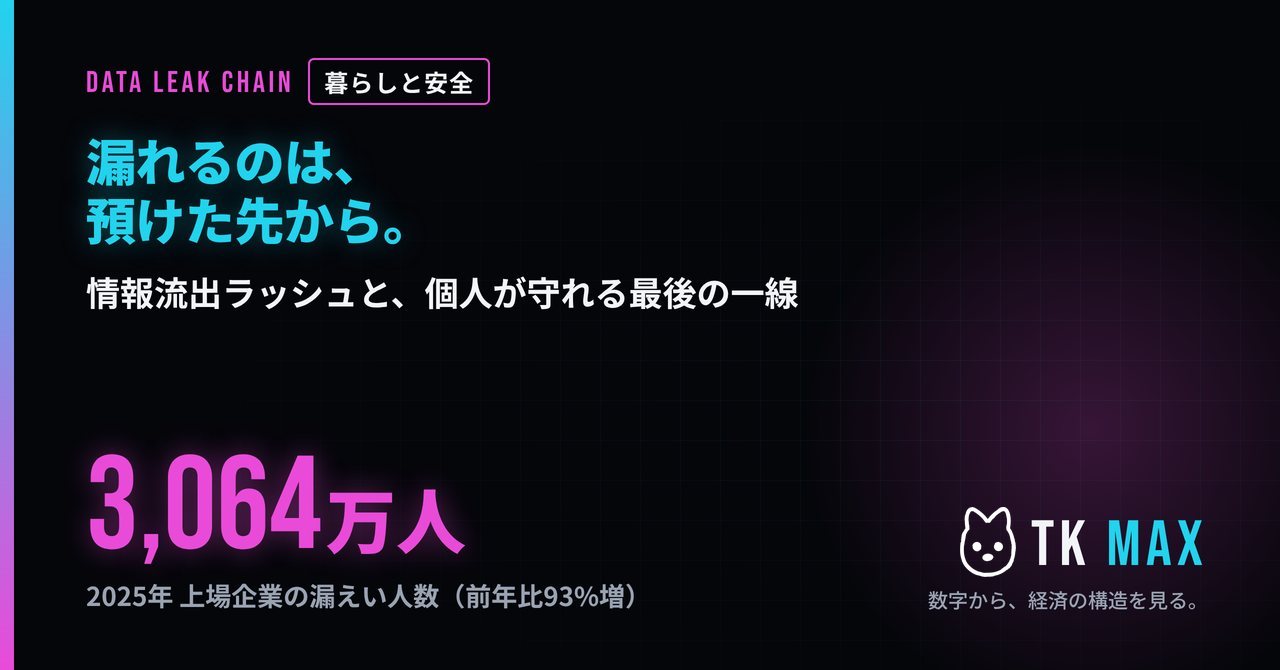
漏れるのは、預けた先から。It Leaks From Where You Left It. ―― 情報流出ラッシュと、個人が守れる最後の一線— The data-breach wave, and the last line individuals can hold
2026年9月下旬から10月上旬にかけて、日本では個人情報の流出が連日のように公表されました。レンタカー、コンビニの会員ID、カラオケ、旅行予約、鉄道の予約サイト。共通していたのは、狙われたのが会社の「本体」ではなく、委託先・共通のクラウド・スマホアプリの裏口だったことです。同じことは欧州でも起きています。このダッシュボードは、流出の入口と連鎖、国ごとの罰則の差、そして個人の側で被害の届く範囲をどこまで狭められるかを、公開データで並べます。
From late September to early October 2026, personal-data leaks were announced in Japan almost daily: car rental, a convenience-store member ID, karaoke, travel booking, rail reservations. What they shared was that attackers hit not the company "core" but contractors, shared cloud platforms, and the back doors of smartphone apps. The same is happening in Europe. This dashboard lays out, from public data, where leaks enter and how they chain, how penalties differ by country, and how far an individual can limit the reach of the damage.
📄=企業・官公庁の公表資料、または複数の報道で確認された事実。📊=数字や事例の並びから読み取れる関係(因果の断定ではない)。💬=専門家の間でも評価が割れている解釈。🌐=ネット上で語られる説(本ページは紹介にとどめ、採用しない)。件数の「最大」は各社が示した想定上限で、実際の流出数ではありません。📄 = releases by companies or authorities, or facts confirmed by multiple outlets. 📊 = relationships read from the data or cases (not a causal claim). 💬 = interpretations on which experts disagree. 🌐 = theories circulating online (introduced only, not adopted). "Up to" figures are each company's stated upper bound, not confirmed leak counts.
OVERVIEW流出は「事故」から「連鎖」へLeaks have shifted from "accidents" to "chains"
かつての情報漏えいは、USBメモリの紛失やメールの誤送信といった「うっかり」が中心でした。いまは違います。東京商工リサーチの集計では、2025年に上場企業とその子会社が公表した漏えい事故180件のうち、64.4%がウイルス感染・不正アクセスでした。しかも1件あたりの規模が大きくなり、100万人以上の大型事故は前年の2件から6件に増えています。
Data leaks used to be mostly "slip-ups": a lost USB stick, a misdirected email. Not anymore. Per Tokyo Shoko Research, of 180 leak incidents disclosed by listed companies and subsidiaries in 2025, 64.4% were malware or unauthorized access. Each incident is also getting bigger: cases affecting 1 million+ people rose from 2 the year before to 6.
JAPAN'S CHAIN2026年秋、2週間で何が起きたかWhat happened in two weeks, autumn 2026
流出ラッシュの前兆は8月からありました。そして9月下旬から10月上旬に、公表が一気に重なり、10月中旬に入っても続いています。日付は各社・各機関の公表日です。
Warning signs appeared from August. Then, from late September to early October, announcements piled up, and they continued into mid-October. Dates are each organization's announcement date.
規模の大きい事案と「入口」の種類Largest cases and their "entry type"
| 公表日Date | 組織Organization | 件数Records | 入口Entry |
|---|---|---|---|
| 09/16 | Gyazo(Helpfeel) | 約2,362万≈23.62M | 自社システムOwn system |
| 10/15 | ソースネクストSourcenext | 最大2,251万≤22.51M | 自社システムOwn system |
| 10/09 | skyticket | 最大1,464万≤14.64M | 自社システムOwn system |
| 10/05 | 焼肉きんぐ(物語コーポレーション)Yakiniku King (Monogatari) | 約1,079万≈10.79M | 自社システムOwn system |
| 10/08 | 第一興商Daiichikosho | 約872万≈8.72M | 委託先Contractor |
| 09/25 | タイムズカーTimes Car | 最大660万≤6.6M | 自社システムOwn system |
| 10/09 | ブックオフBook Off | 最大643万≤6.43M | 自社系(子会社)Group subsidiary |
| 09/28 | 手間いらず(予約管理)Temairazu (booking system) | 最大445万≤4.45M | 共通の業務システムShared business system |
| 10/09 | ディップ(バイトル)dip (Baitoru) | 最大389万≤3.89M | 自社システムOwn system |
| 10/08 | ローソンIDLawson ID | 約216万≈2.16M | 自社システムOwn system |
| 10/09 | JR東日本(えきねっと等)JR East (Eki-net etc.) | 最大206万≤2.06M | 共通クラウドShared cloud |
| 10/09 | JR九州JR Kyushu | 最大130万≤1.3M | 共通クラウドShared cloud |
各社の公表値(集計:ウェステリア「2026年の情報漏洩事案一覧」ほか)。「件」はレコード数で、同じ人が重複して数えられている場合があります。「自社システム」には、スマホアプリやWebサイトの仕組みの不備を突かれたものを含みます。Company-announced figures (compiled by Westeria and others). "Records" may count the same person more than once. "Own system" includes flaws in a company's own apps or websites.
WHERE IT GETS IN狙われるのは「本体」ではなく「周辺」The target is the "periphery," not the "core"
JPCERT/CCが整理した3つの手口(2026年10月8日)Three methods identified by JPCERT/CC (Oct 8, 2026)
情報の預け先は、何段にもなっているData is entrusted through many layers
利用者が同意するのは、左から2番目の「サービス企業」までです。その先に何社が関わっているかは、ふだん見えません。2026年秋の事案では、この見えない3段目から漏れたケースが目立ちました。
Users consent only as far as the "service company." How many firms sit behind it is normally invisible. In the autumn-2026 cases, leaks from this invisible third layer stood out.
| 型Pattern | 国内の例Japan examples | 海外の例Overseas examples |
|---|---|---|
| 委託先経由Via contractor | 第一興商(委託先社員PC)、大和証券(委託先FAQシステム)、旭化成セラピューティクス(委託先の会員DB)、伊勢崎市ほか(両毛システムズのVPN)Daiichikosho (contractor PC), Daiwa Securities (contractor FAQ system), Asahi Kasei Therapeutics (contractor member DB), Isesaki City etc. (Ryomo Systems VPN) | 仏 France Travail(提携先担当者になりすまし、最大4,300万人)France Travail (impersonating partner advisers; up to 43M) |
| 共通基盤経由Via shared platform | IDCFクラウド(495の企業・自治体)、手間いらず(宿泊予約管理)IDCF Cloud (495 organizations), Temairazu (hotel booking) | 空港の搭乗手続きシステム(Collins Aerospace、2025年9月)、スウェーデンの自治体向けSaaS(Miljödata、150万人超)、欧州委員会のクラウド(2026年3月)Airport check-in system (Collins Aerospace, Sep 2025), Swedish municipal SaaS (Miljödata, 1.5M+), European Commission cloud (Mar 2026) |
| 持ち続けたデータData kept too long | タイムズカー(退会済み利用者も対象)Times Car (former members included) | 韓国 クーパン(元社員が鍵を悪用、3,755万人)Coupang, Korea (ex-employee misused keys; 37.55M) |
報告件数で見るとBy reported cases
OVERSEAS & EUROPE日本だけの問題ではないNot just Japan's problem
欧州では2026年上半期だけで、ランサムウェア攻撃が866件記録されました。被害が多いのはドイツ、イギリス、フランス、イタリア、スペイン。業種では製造業と建設業が上位です。
Europe logged 866 ransomware attacks in the first half of 2026 alone. Germany, the UK, France, Italy, and Spain were hit most; manufacturing and construction led by sector.
主な事例Major cases
| 国・地域Country | 組織・時期Organization / when | 何が起きたかWhat happened |
|---|---|---|
| イギリスUK | ジャガー・ランドローバー(2025年)Jaguar Land Rover (2025) | 📄生産が約6週間停止。英国経済への損失は約19億ポンドと推計され、5,000社超の取引先に波及。政府が15億ポンドの融資保証を出した。Production halted for ~6 weeks. UK economic loss estimated at ~£1.9B, spreading to 5,000+ suppliers. The government provided a £1.5B loan guarantee. |
| イギリスUK | マークス&スペンサー(2025年4月)Marks & Spencer (Apr 2025) | 📄ネット通販が約2か月停止。損失は約3億ポンド。Online sales halted ~2 months; loss ~£300M. |
| イギリスUK | 生協 Co-op(2025年)Co-op (2025) | 📄会員約650万人分の情報が盗まれ、損失は2億600万ポンド。Data on ~6.5M members stolen; loss of £206M. |
| フランスFrance | France Travail(公共職業安定所、2024年)France Travail (public employment service, 2024) | 📄提携先の担当者になりすまして求職者データベースを照会。最大4,300万人分。Attackers posed as partner advisers to query the jobseeker database; up to 43M people. |
| フランスFrance | 通信会社 Free(2024年10月)Telecom operator Free (Oct 2024) | 📄約1,920万契約。うち約511万件は銀行口座番号(IBAN)を含む。~19.2M accounts, ~5.11M including bank account numbers (IBAN). |
| EU機関EU institutions | 欧州委員会(2026年3月)European Commission (Mar 2026) | 📄開発用の無料ツールが乗っ取られ、そこからクラウドの鍵が盗まれた。ほかのEU機関29か所にも影響の可能性。A compromised open-source dev tool led to a stolen cloud key; 29 other EU bodies possibly affected. |
| 欧州各国の空港European airports | Collins Aerospace(2025年9月)Collins Aerospace (Sep 2025) | 📄複数の空港が共用する搭乗手続きシステムがランサムウェアで停止。ブリュッセル、ベルリン、ロンドン・ヒースローなどで手作業対応に。A check-in system shared by many airports was knocked out by ransomware; Brussels, Berlin, Heathrow and others fell back to manual processing. |
| 韓国South Korea | クーパン(2025年発覚)Coupang (discovered 2025) | 📄元IT部門社員とされる人物が認証鍵を悪用し、約3,755万人分が流出。2026年に過去最高の6,246億ウォン(約4億900万ドル)の課徴金。An ex-IT employee misused authentication keys; ~37.55M people affected. Fined a record ₩624.6B (~$409M) in 2026. |
| 韓国South Korea | SKテレコム(2025年発覚)SK Telecom (discovered 2025) | 📄マルウェア感染で約2,700万契約分のSIM関連情報が流出。Malware exposed SIM-related data on ~27M subscribers. |
| アメリカUSA | Change Healthcare(2024年)Change Healthcare (2024) | 📄多要素認証のない遠隔接続の入口から侵入。約1億9,270万人分と、過去最大級の医療情報流出に。Entry via a remote-access portal without multi-factor authentication; ~192.7M people, among the largest health-data breaches ever. |
WHO PAYS漏らした側と、漏らされた側The side that leaked, and the side that was leaked
流出が起きたとき、お金はどこから出て、どこに行くのか。国によって仕組みが大きく違います。
When a leak happens, where does the money come from and where does it go? The answer varies widely by country.
| EU(GDPR) | 韓国South Korea | 日本Japan | |
|---|---|---|---|
| 制裁金の上限Fine ceiling | 2,000万ユーロ または 全世界売上高の4%(高い方)€20M or 4% of global turnover (whichever is higher) | 売上高の最大3%Up to 3% of revenue | 漏えいそのものに課徴金はない。命令違反への罰金(法人は最大1億円)のみNo surcharge for a leak itself; only criminal fines for defying orders (up to ¥100M for corporations) |
| 実績Track record | 2025年の総額 約12億ユーロ。最大はTikTok 5億3,000万ユーロ(中国へのデータ移転)~€1.2B total in 2025; largest: TikTok €530M (data transfers to China) | クーパンに6,246億ウォン(2026年、過去最高)Coupang ₩624.6B (2026, record) | 行政指導・勧告が中心Mainly guidance and recommendations |
| 届け出Notifications | 1日平均443件(前年比22%増)443 per day on average (+22%) | — | 民間17,139件/年度(2025年度)17,139 private-sector reports (FY2025) |
| 最近の改正Recent reform | — | — | 2026年7月公布の改正法で課徴金を導入(公布から2年以内に施行)。対象は不適正な利用・不正な取得・第三者提供の違反など。漏えいを防ぐ義務(安全管理)は対象に含まれていないA law promulgated in July 2026 introduces surcharges (in force within 2 years), covering improper use, improper acquisition, unlawful third-party provision, etc. The duty to prevent leaks (security management) is not included. |
出典:DLA Piper GDPR制裁金調査2026、韓国個人情報保護委員会、個人情報保護委員会 令和7年度年次報告、改正個人情報保護法(2026年7月17日公布)。Sources: DLA Piper GDPR survey 2026, Korea PIPC, Japan PPC annual report FY2025, amended APPI (promulgated Jul 17, 2026).
改正法の中身を、もう一歩くわしくA closer look at the 2026 amendment
2026年7月に公布された改正法で、日本にも初めて課徴金が入りました。ただ、EUのGDPRと並べると、制度の考え方が大きく違います。
The amendment promulgated in July 2026 brings administrative surcharges to Japan for the first time. Set beside the EU's GDPR, though, the underlying approach is very different.
| 項目Item | 日本(改正後)Japan (amended) | EU(GDPR) |
|---|---|---|
| 金額の基準Basis of the amount | 違反行為で得た利益に相当する額(売上高には比例しない。算定方法は政令で決める)An amount equal to the profit gained from the violation (not tied to revenue; method set by cabinet order) | 全世界売上高の最大4%、または2,000万ユーロの高い方Up to 4% of global turnover or €20M, whichever is higher |
| 対象となる違反Violations covered | 不適正な利用・不正な取得・第三者提供の違反・統計目的データの目的外利用の4類型。対象者1,000人以下は対象外。安全管理(漏えい防止)の不備は含まれないFour types: improper use, improper acquisition, unlawful third-party provision, misuse of statistics-purpose data. Not imposed when 1,000 people or fewer are affected. Security failures (leak prevention) are not included. | 安全管理の不備も対象(上限は売上高の2%または1,000万ユーロ)Security failures are covered too (up to 2% of turnover or €10M) |
| 不要になったデータData no longer needed | 遅滞なく消去するよう「努める」(努力義務・罰則なし)Must "endeavor" to delete without delay (a best-effort duty with no penalty) | 必要な期間を超えて保存しないのが原則(保存制限の原則)。違反は制裁金の対象May not be kept longer than necessary (storage limitation principle); violations can be fined |
| 本人への通知Notifying individuals | 通知が困難な場合は「公表」で代えられる。改正で、暗号化などで本人の権利利益の保護に欠けるおそれが少ない場合は、通知を免除する方向Public announcement may replace notice when notice is difficult. The amendment moves to exempt notice where risk to individuals is low, e.g. data was encrypted | リスクが高い場合に本人へ通知。暗号化済みなら不要、個別の通知が過大な負担なら公表で代えられるNotify individuals when risk is high; not needed if data was encrypted; public communication allowed when individual notice is disproportionate |
| データの活用Data use | 統計作成・AI開発が目的なら、公表などの要件を満たせば本人の同意なしで利用・提供できる特例を新設New exception: for statistics or AI development, data may be used or shared without consent if publication and other conditions are met | 同意以外にも「正当な利益」などの根拠で利用できるが、根拠を示す責任は企業側Grounds other than consent (e.g. legitimate interests) exist, but the company bears the burden of justifying them |
出典:改正個人情報保護法(2026年7月17日公布、公布から2年以内に施行)の解説(ISSOH、CDP)、GDPR第5条・第32条・第34条・第83条。課徴金の算定方法や通知免除の具体的な要件は、今後の政令・規則で決まります。Sources: commentaries on the amended APPI (promulgated Jul 17, 2026, in force within two years) by ISSOH and CDP; GDPR Arts. 5, 32, 34, 83. The surcharge calculation and the exact notice-exemption criteria will be set by later orders and rules.
これに対しネット上では「企業が守れないのに個人で守れるのか」「国は守らないのか」と反発が広がりました。一方で、「流出したあとの悪用を防ぐための呼びかけで、見出しだけが一人歩きした」という擁護の声もあります。
どちらの読み方をしても、残る事実は一つです。個人がすべての対策をしていても、預けた先から漏れる情報は止められません。個人に止められるのは、漏れたあと被害がお金まで届く道だけです。At his Oct 6 press conference, Digital Minister Toshiharu Furukawa urged people to "keep in mind: protect your own information yourself" and cooperate in preventing harm, citing personal measures: no password reuse, multi-factor authentication, and caution about phishing.
Online, many pushed back: "If companies can't protect it, how can individuals?" "Won't the state protect us?" Others defended him, saying it was a call to prevent misuse after leaks and that the headline took on a life of its own.
Either way, one fact remains: even if an individual does everything right, data leaking from where it was entrusted can't be stopped. What individuals can block is only the path from a leak to their money.
技術的に難しいことではありません。多くの企業がやらない理由は、手間とコストがかかること、休眠会員にも販促を送りたいこと、そして日本ではやらなくても罰則がないことです。タイムズカーの流出に退会済みの利用者まで含まれていたのは、その表れといえます。Data on members who haven't logged in for years isn't used in day-to-day service. Moving it out of live systems into separate storage, and deleting what isn't needed, is a security basic called "data minimization." Then, even if the live system is breached, dormant members' data doesn't leak with it.
It isn't technically hard. Many companies skip it because it costs time and money, because they want to keep marketing to dormant members, and because in Japan there's no penalty for not doing it. That Times Car's leak included former members is one sign of this.
日本の「お詫び」の相場Japan's "apology" norm
コストはどこに残るかWhere the cost ends up
・お詫びの金券・コールセンター
・システム停止中の売上減
・(欧州・韓国では)制裁金• Investigation and recovery
• Apology vouchers, call centers
• Lost sales during downtime
• (In Europe/Korea) fines
・本人確認書類の画像は、なりすまし契約に使われ得る
・「流出のお詫び」を装った詐欺連絡
・被害の因果関係を証明しにくく、補償されにくい• Names, phones, addresses can't be changed
• ID-document images can be used for fraudulent contracts
• Scam messages posing as "leak apologies"
• Harm is hard to trace back, so rarely compensated
WHAT YOU CAN DO流出は止められない。届く範囲は狭められるYou can't stop leaks. You can narrow their reach.
預けた先が漏れるかどうかは、利用者には決められません。決められるのは、漏れたときに被害がどこまで届くかです。氏名や住所は守りきれなくても、お金とアカウントに届く道は自分で塞げます。できているものにチェックを入れてみてください(チェックはこの端末にだけ保存されます)。
Whether the places you've entrusted data to will leak isn't your call. What you can decide is how far the damage reaches when they do. You may not be able to protect your name and address, but you can close the paths to your money and accounts. Tick what you already do (ticks are saved only on this device).
SIMULATOR流出したとき、被害はどこまで届くかWhen a leak happens, how far does it reach?
5つの前提を動かすと、流出の被害が「連絡先」「アカウント」「お金」の3つの層にどこまで届くかが変わります。予測ではなく、自分で変えられる前提と、変えられない前提を見分けるための道具です。どこから触ればいいか迷ったら、まずシナリオを選んでください。
Move five assumptions to see how far a leak reaches into three layers: contact details, accounts, and money. Not a forecast — a tool to separate the assumptions you can change from those you can't. If unsure where to start, pick a scenario first.
計算方法を見る(透明性のため公開)See the method (disclosed for transparency)
N=サービス数、p=1サービスの年間流出確率、r=使い回し率、m=2段階認証率、c=カード直登録率。
① 連絡先層=1年で少なくとも1か所から漏れる確率=1−(1−p)N
② アカウント層=1か所の流出から芋づるで入られる割合=r×(1−m)
③ お金層=そのうちカード番号が登録されている割合=r×(1−m)×c
全体=①×0.3+②×0.35+③×0.35。0〜34=SAFE、35〜64=WARNING、65以上=CRISIS。
N = services, p = annual leak chance per service, r = reuse rate, m = 2-step rate, c = stored-card rate.
① Contact layer = chance at least one leaks in a year = 1−(1−p)N
② Account layer = share reachable by cascade from one leak = r×(1−m)
③ Money layer = share of those holding a card = r×(1−m)×c
Overall = ①×0.3 + ②×0.35 + ③×0.35. 0–34 SAFE, 35–64 WARNING, 65+ CRISIS.
流出確率pは公開統計から直接求められないため、目安として置いた例示値です。数字の大小より、①は自分で下げにくく、②③は自分で大きく下げられるという違いに注目してください。
The leak chance p can't be derived directly from public statistics, so it's an illustrative value. Focus less on the numbers than on the difference: ① is hard for you to lower, while ② and ③ you can cut sharply yourself.
※本シミュレーターは教育・研究目的の思考実験です。特定の企業の流出や、個人の被害の有無を予測するものではありません。*This simulator is a thought experiment for education and research. It doesn't predict any company's leak or any individual's harm.
BOTH SIDES「企業の怠慢」と「攻撃の高度化」――同じ事件の二つの読み方"Corporate negligence" vs. "smarter attacks" — two readings of the same events
・退会者のデータまで持ち続けていた
・委託先やクラウドの管理を丸投げしている
・日本は漏えいへの制裁が弱く、対策にお金をかける動機が小さい • Per JPCERT/CC, attackers used already-known flaws; patching would have stopped them
• Data on former members was kept
• Oversight of contractors and cloud is left to others
• Weak penalties in Japan reduce the incentive to invest in defense
・クラウド事業者が攻撃されると、利用企業には防ぎようがない
・中小企業や自治体には、専門人材も予算も足りない
・制裁を強めすぎると、報告や公表をためらう方向に働くおそれ • Attacks are organized and concentrated in a few groups
• When a cloud provider is hit, its customers can't prevent it
• SMEs and local governments lack staff and budgets
• Overly harsh penalties may discourage reporting and disclosure
SOURCES(データ・出典) (Data & Sources)
- Web担当者Forum「2025年の個人情報漏えい、被害人数は3,063万人」(東京商工リサーチ調べ)Web Tantosha Forum: 2025 leaks affected 30.63M (Tokyo Shoko Research) webtan.impress.co.jp
- ScanNetSecurity「100万人以上の大型事故が前年から3倍増」ScanNetSecurity: 1M+ incidents tripled scan.netsecurity.ne.jp
- 個人情報保護委員会 令和7年度年次報告(漏えい等報告件数)PPC annual report FY2025 (leak report counts) kaiketsu-j.com
- piyolog「IDCFクラウドへのランサムウェア攻撃についてまとめてみた」piyolog: summary of the IDCF Cloud ransomware attack piyolog.hatenadiary.jp
- ウェステリア「2026年の情報漏洩・不正アクセス・ランサムウェア事案一覧」Westeria: 2026 list of leak, intrusion and ransomware cases in Japan westeria.jp
- Impress Watch「国内で情報漏えい被害が相次ぐ JPCERT/CCが攻撃手法と対策を公表」(2026年10月8日)Impress Watch: JPCERT/CC publishes methods and countermeasures (Oct 8, 2026) watch.impress.co.jp
- @IT「タイムズカーで不正アクセス 約660万件の情報が流出」@IT: Times Car breach, ~6.6M records atmarkit.itmedia.co.jp
- Impress Watch「JR東日本 えきねっと等 最大約206万件」Impress Watch: JR East Eki-net, up to ~2.06M watch.impress.co.jp
- 金融庁の注意喚起(ICチップ方式への移行前倒し、2026年10月9日)FSA alert on moving to IC-chip verification early (Oct 9, 2026) rocket-boys.co.jp
- ScanNetSecurity「個人情報の保護に関する法律等の一部を改正する法律」公布(課徴金制度)ScanNetSecurity: amended APPI promulgated (surcharge system) scan.netsecurity.ne.jp
- NHK「ソースネクスト 約2251万件の個人情報が流出か 不正アクセスで」(2026年10月15日)NHK: Sourcenext, ~22.51M records possibly leaked (Oct 15, 2026) news.web.nhk
- Hakky「ソースネクスト、個人情報流出か。最大2251万件に上る可能性」Hakky: Sourcenext leak, up to 22.51M (items involved) book.st-hakky.com
- 週刊女性PRIME「古川デジタル相『自分の情報は自分で守る』発言に不信の声」Shukan Josei PRIME: backlash to the digital minister's remark jprime.jp
- アゴラ「古川大臣の10月6日の記者会見で実際に言ったこと」(会見録の引用)Agora: what the minister actually said on Oct 6 (transcript quoted) agora-web.jp
- ISSOH「個人情報保護法改正とは?令和8年改正で企業対応はこう変わる」(課徴金の対象・算定、通知免除、統計特例)ISSOH: the 2026 APPI amendment explained (surcharges, notice exemption, statistics exception) issoh.co.jp
- CDP「個人情報保護法と海外のデータ保護法一覧|罰則と2026年改正」CDP: Japan's APPI vs. overseas data-protection laws, penalties and the 2026 amendment cdp.com
- Cyble — Ransomware Threats in Europe H1 2026 cyble.com
- UpGuard — Biggest Data Breaches in Europe upguard.com
- TechCentral / DLA Piper — European GDPR fines totalled approximately €1.2bn in 2025 techcentral.ie
- DTNext / Cyber Monitoring Centre — JLR cyberattack costs UK economy £1.9bn dtnext.in
- Retail Systems — Co-op admits losing £206m after cyber-attack retail-systems.com
- BleepingComputer — South Korea hits Coupang with record $409 million fine bleepingcomputer.com
- CM-Alliance — Major cyber attacks and data breaches, September 2026 cm-alliance.com
- Have I Been Pwned haveibeenpwned.com
データは2026年10月17日時点の公開情報に基づきます。各社の調査は続いており、件数は続報で変わることがあります。最新の数字は各出典でご確認ください。Data reflect public information as of October 17, 2026. Investigations continue and figures may change in later updates; check each source for the latest.
※本ページは公開資料・報道をもとにした教育・研究目的の分析です。特定の企業を非難・評価するものではありません。件数は各社の公表時点のもので、続報で変わる場合があります。個別の被害については、各社の公式窓口や警察・消費生活センターにご相談ください。
*This page is an educational and research analysis based on public materials and reporting. It does not condemn or rate any company. Figures are as of each company's announcement and may change. For individual harm, contact the company's official channel, the police, or a consumer center.