音声解説(AI生成)
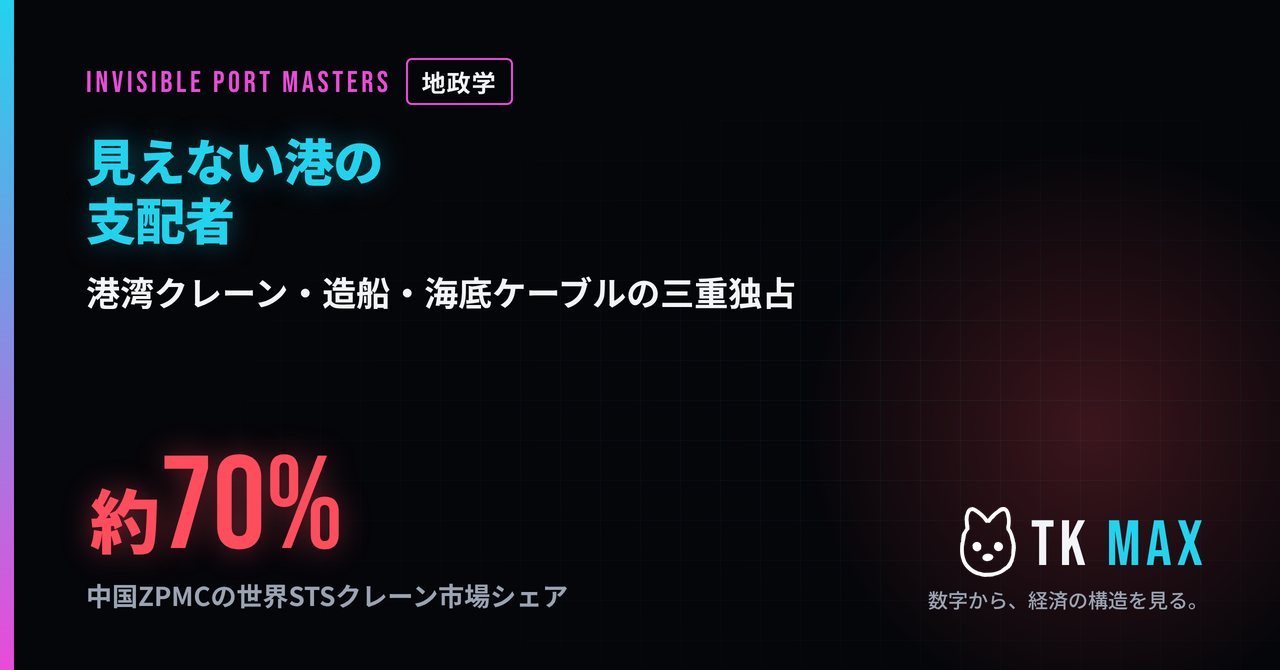
チョークポイントは半導体だけではない。世界の海上貿易の約9割はコンテナ船が担い、その積み下ろしを担うSTS(ship-to-shore)クレーンの世界市場で、中国・上海振華重工(ZPMC)は約7割、米国内では約8割のシェアを握るとされる。さらに商船隊そのものも中国籍・中国建造船が急拡大しており、造船受注の世界シェアは年によって6〜8割に達する。港(クレーン)・船(造船)・線(海底ケーブル)――貿易とデータが物理的に通過する3つの経路すべてで、中国の存在感が構造的に積み上がってきた。
これは前作「21世紀の兵糧攻め」が扱った半導体・特殊ガス・レアアースの規制ドミノの、いわば"物流版"の続章にあたる。ただし今回の非対称性は、中国の規制発動によって生まれたものではなく、米国自身が数十年かけて自国の造船・海運能力を空洞化させてきた結果という側面が強い――その構造は③タブで詳しく扱う。
Chokepoints aren't limited to semiconductors. Roughly 90% of world seaborne trade moves by container ship, and in the global market for ship-to-shore (STS) cranes that load and unload them, China's Shanghai Zhenhua Heavy Industries (ZPMC) is estimated to hold about 70% share worldwide and roughly 80% within the US itself. China's own commercial fleet and China-built vessels have also expanded sharply, with China's share of global shipbuilding orders reaching 60–80% in some years. Ports (cranes), ships (shipbuilding), and cables (undersea data lines) — the three physical channels through which trade and data actually move — have all seen China's presence build up structurally over time.
This is, in effect, the "logistics-layer" sequel to our earlier piece on the semiconductor/specialty-gas/rare-earth control domino, "The 21st-Century Siege." But this asymmetry wasn't created by a Chinese regulatory strike — it largely reflects decades of the US itself hollowing out its own shipbuilding and maritime capacity, a structural story covered in Tab ③.
米国は第二次世界大戦中、世界最大の造船能力を誇った国である。その米国が今や年間の新造船建造で世界シェア1%にも満たず、商業船隊は100隻未満、米国旗を掲げる船舶は世界の0.4%未満という水準まで落ち込んでいる。これは中国が規制で奪った市場ではなく、コスト構造・労働力・産業政策の長期的な変化の中で自ら手放してきた市場という側面が大きい――今回のマトリクスにおける「自滅の構造」は、規制の応酬というより、数十年単位の空洞化そのものである。
The US once had the world's largest shipbuilding capacity during World War II. Today it accounts for under 1% of annual global new-ship construction, its commercial fleet numbers fewer than 100 vessels, and less than 0.4% of world shipping flies the US flag. This wasn't a market China seized through regulation — it's largely a market the US let go of itself, over decades of shifting cost structures, labor economics, and industrial policy. Here, the matrix's "self-inflicted wound" isn't a tit-for-tat regulatory exchange — it's the hollowing-out itself, compounding over decades.
🚢 商船隊5500隻 vs 100隻未満
中国は5500隻を超える商業船隊を保有するとされる一方、米国の商業船隊は100隻に満たない。米国で建造される新造船は世界の1%未満、米国旗船は0.4%未満という指摘もある。
China is estimated to operate a commercial fleet of over 5,500 vessels, while the US fleet numbers under 100. US-built new ships account for under 1% of the global total, and less than 0.4% of world shipping flies the US flag, by some estimates.
🔌 「無許可のモデム」問題
米下院報告書は、ZPMC製クレーンに港湾側が発注していないセルラーモデムが搭載されていたと指摘した。港湾クレーンは物理的な荷役機械であると同時に、遠隔ファームウェア更新等が可能な"ネットワーク端末"でもある――「クレーンOS」を誰が握るかという論点が、規制論の核にある。
The House report found cellular modems on ZPMC cranes that ports never requested. A port crane is both a physical loading machine and, increasingly, a networked endpoint capable of remote firmware updates — the debate over "who controls the crane's OS" sits at the core of the policy concern.
🏗️ 名古屋港の教訓
2023年の名古屋港ランサムウェア攻撃は中国製クレーンとは無関係だが、港湾ターミナルシステム全体がリモート接続機器の脆弱性一つで丸1日以上停止しうることを実証した。港湾インフラのサイバー脆弱性は、供給元の国籍を問わず共通の弱点である。
The 2023 Nagoya ransomware attack had nothing to do with Chinese cranes, but it demonstrated that an entire port terminal system can be paralyzed for over a day by a single vulnerable remote-access device. Cyber fragility in port infrastructure is a shared weakness, regardless of equipment origin.
🧱 代替の壁は簡単には越えられない
フィンランドのコネクレーン、ドイツのリープヘル、米国内生産を検討する三井E&S系パセコ等が代替候補として挙がるが、いずれもZPMCの生産規模には遠く及ばず、置き換えには長いリードタイムとコストがかかる。「脱・中国製クレーン」は掛け声としては容易でも、実行には産業基盤そのものの再建が必要になる。
Finland's Konecranes, Germany's Liebherr, and Mitsui E&S's Paceco (weighing US production) are floated as alternatives, but none approach ZPMC's production scale, and replacement requires long lead times and heavy cost. "De-risking from Chinese cranes" is an easy slogan but requires rebuilding an entire industrial base to execute.
日本は今回のマトリクスにおいて、中国依存を軽減したい米欧が頼る「代替供給者」候補の一つに位置づけられている。港湾クレーンでは三井E&S・パセコ、海底ケーブルでは長い実績を持つNECや国際ケーブル・シップが存在感を持つ。ただし供給能力・コスト面では中国製に及ばない構造は同様であり、「頼られる側」としての限界も抱える。
In this matrix, Japan is positioned as one of the candidate "alternative suppliers" the US and Europe look to as they try to reduce China dependence — Mitsui E&S/Paceco in port cranes, and NEC and Kokusai Cable Ship with their long track record in undersea cables. But Japan faces the same structural gap in supply capacity and cost versus Chinese producers, and has its own limits as the "supplier of last resort."
🏭 三井E&S・パセコという選択肢
三井E&Sの米国子会社パセコは、実は米国におけるSTSクレーンの生みの親(1959年に世界初のSTSクレーンを開発)とされる企業である。米議員提言でも代替候補として名指しされたが、現在の生産規模はZPMCとは比較にならないほど小さく、米国内製造の再拡大には投資・人材育成が必要とされる。
Mitsui E&S's US subsidiary Paceco is, notably, the company credited with inventing the world's first STS crane back in 1959. Named as a candidate alternative in US lawmakers' proposals, but its current production scale is nowhere near ZPMC's, and re-expanding US manufacturing would require fresh investment and workforce development.
🌐 海底ケーブルにおける日本の立ち位置
世界の海底ケーブルの製造・敷設は、中国の華海通信技術、米国のサブコム、フランスのアルカテル・サブマリン・ネットワークス、日本のNECの4社が実質的に担うとされる。日本はこの数少ないプレーヤーの一角であり、沖縄をアジア太平洋の通信ハブとして強化する構想も議論されている。
Global undersea cable manufacturing and laying is effectively handled by four players: China's HMN Technologies, the US's SubCom, France's Alcatel Submarine Networks, and Japan's NEC. Japan is one of this small handful, and there is ongoing discussion of strengthening Okinawa as an Asia-Pacific communications hub.
⚓ 自前のケーブル敷設船隊確保という論点
シンクタンク等からは、権威主義国に依存しないケーブル敷設・保守ルートの整備と、日本主権のケーブル敷設船隊確保の必要性が指摘されている。海底ケーブルの敷設・修理は専用船に依存する高度に集中した産業であり、船舶そのものの確保が交渉力に直結する。
Think tanks have flagged the need to build cable-laying and maintenance routes independent of authoritarian states, and to secure a Japan-flagged cable-laying fleet of its own. Undersea cable laying and repair is a highly concentrated industry dependent on specialized vessels — controlling the ships themselves is directly tied to negotiating leverage.
💰 コスト差という現実
中国の華海通信技術は競合より2〜3割安くケーブルを敷設できるとされ、価格競争力で新興国市場への食い込みを強めている。日本を含む非中国勢が対抗するには、価格以外の価値(安全保障上の信頼性等)を顧客にどう説得するかが課題となる。
China's HMN Technologies reportedly can lay cable 20–30% cheaper than competitors, strengthening its foothold in emerging markets on price alone. For Japan and other non-Chinese players to compete, the challenge is persuading customers to value something beyond price — such as security and trust.
米国は港湾クレーンの8割、造船需要の大半を中国(製)に依存しながら、同時にその依存を「安全保障上の脅威」として規制しようとする、二律背反の立場に置かれている。港を止めずに中国製クレーンから離脱する方法は存在せず、対抗策は必然的に時間のかかる産業再建策とならざるを得ない。
The US depends on China for roughly 80% of its port cranes and the bulk of new-ship supply, even as it moves to regulate that same dependence as a security threat — a genuine bind. There is no way to walk away from Chinese-made cranes without stopping the ports, so any countermeasure necessarily becomes a slow, industrial-rebuilding project.
📜 Section 301措置の骨格
2025年10月14日発効のUSTR措置は、中国船舶運航者への入港料(純トン数当たり50〜80ドル)、中国建造船への追加料金、外国建造自動車運搬船への課金、中国製STSクレーン・荷役機器への100〜150%関税という4本柱からなる。ただし一部は2026年11月まで一時停止されている。
USTR's measures, effective October 14, 2025, rest on four pillars: port-entry fees on Chinese vessel operators ($50–80/net ton), surcharges on China-built ships, fees on foreign-built car carriers, and 100–150% tariffs on Chinese-made STS cranes and cargo-handling equipment. Some elements are suspended until November 2026.
⚓ SHIPS for America Act と海事行動計画
議会に再提出されたSHIPS法案は、2035年までに米国旗船を250隻へ増やす目標を掲げる。政権の海事行動計画も、税制優遇・造船所再建・船員育成・許認可改革を柱に掲げるが、年間数百隻を建造する中国との差を埋めるには長期的な取り組みが必要とされる。
The re-introduced SHIPS for America Act targets 250 US-flagged ships by 2035. The administration's Maritime Action Plan likewise centers on tax incentives, shipyard rebuilding, workforce training, and permitting reform — but closing the gap with a China that adds hundreds of ships a year will take a sustained, long-term effort.
🔍 議会報告書が突いた「クレーンOS」問題
下院・中国特別委員会の報告書は、港湾側が発注していないセルラーモデムの存在を指摘し、遠隔ソフトウェア更新機能を持つクレーンが有事に操作・停止させられるリスクを警告した。ZPMC側はこれを否定し、「安全保障上のリスクはない」と反論している。
The House Select Committee report flagged unrequested cellular modems and warned that cranes with remote software-update capability could theoretically be manipulated or disabled in a crisis. ZPMC has pushed back, insisting there is "no security risk."
🤝 一時停止という"休戦"の脆さ
米中首脳会談を経た2026年11月までの一時停止は、レアアース規制の1年間休戦と同型の展開である。その間に中国の造船受注シェアは85%まで急伸しており、規制の一時停止自体が中国側への発注集中を招くという皮肉な結果も観測されている。
The suspension through November 2026, following the US-China summit, mirrors the one-year rare-earth truce pattern. During this window, China's shipbuilding-order share surged to 85% — an ironic outcome where the pause in enforcement itself appears to have driven orders back toward China.
太平洋の島嶼国にとって海底ケーブルは、大陸から数千キロ離れた孤島を国際通信網につなぐ唯一に近い生命線である。中国はこの地域で低価格を武器にケーブル敷設案件への参入を図る一方、米豪日は安全保障上の懸念から中国企業の排除を働きかけており、島嶼国自身は「安さ」と「信頼性」の間で難しい選択を迫られている。
For Pacific island nations, undersea cables are close to the only lifeline connecting isolated territories thousands of kilometers from any continent to the global communications grid. China has pushed to win cable-laying contracts in the region on price, while the US, Australia, and Japan lobby to exclude Chinese firms on security grounds — leaving island nations themselves caught between "cheap" and "trusted."
🚫 東部マイクロネシアケーブルの入札無効化
世界銀行等が資金支援するキリバス・ナウル・ミクロネシア連邦向けケーブル計画で、中国企業の入札プロセスが安全保障上の懸念から無効とされたと報じられた。低価格提示にもかかわらず排除された事例として、この地域を巡る攻防の象徴となっている。
In a World Bank-backed cable project for Kiribati, Nauru, and the Federated States of Micronesia, a Chinese firm's bidding process was reportedly invalidated over security concerns — despite offering a lower price, becoming a symbolic case in the regional contest.
💵 価格競争力という中国の武器
財政基盤の乏しい島嶼国にとって、華海通信技術が提示する2〜3割安いケーブル敷設案件は魅力的な選択肢である。米豪日が安全保障上の懸念から代替案を提示する場合、価格差をどう埋めるかが実務上の最大の課題となる。
For fiscally constrained island nations, HMN Technologies' 20–30% cheaper cable-laying offers are an attractive option. When the US, Australia, and Japan propose alternatives on security grounds, closing that price gap is the biggest practical hurdle.
🛰️ 「つなぐ側」の交渉力
海底ケーブルの敷設・保守を担える専用船と技術者は世界的に希少で、実質的に中国・米国・フランス・日本の数社に集中している。島嶼国にとっては「誰につないでもらうか」の選択そのものが、外交・安全保障上の意味を持つ決定となる。
The specialized ships and technicians capable of laying and maintaining undersea cables are globally scarce, effectively concentrated among a handful of firms in China, the US, France, and Japan. For island nations, the choice of "who connects us" is itself a decision loaded with diplomatic and security meaning.
🌏 中国の接近と日米豪の警鐘
中国は太平洋島嶼国へのケーブル敷設案件への接近を続けており、日米欧はこれを安全保障上の警戒対象として注視している。通信インフラの物理層を制することが、情報の流れそのものへの影響力につながりうるという懸念が背景にある。
China has continued courting Pacific island nations on cable-laying deals, and Japan, the US, and Europe are watching this closely as a security concern — rooted in the worry that controlling the physical layer of communications infrastructure can translate into influence over the flow of information itself.
米議員提言で代替候補として名指しされたフィンランドのコネクレーンとドイツのリープヘルは、いずれもクレーン分野で世界的な実績を持つ企業だが、STSクレーンの量産規模ではZPMCに遠く及ばない。また韓国は造船分野で中国のシェアを一部奪い返す局面もあり、単一の「対中国」陣営ではなく、分野ごとに異なるプレーヤーが競合・補完し合う構図となっている。
Finland's Konecranes and Germany's Liebherr, both named as candidate alternatives in US lawmakers' proposals, are established global players in crane manufacturing — but neither approaches ZPMC's production scale for STS cranes. Meanwhile, Korea has at times clawed back shipbuilding share from China. Rather than a single unified "anti-China" bloc, different players compete and complement each other sector by sector.
🏗️ コネクレーン・リープヘルの実力と限界
両社ともクレーン技術では定評があるが、ZPMCが国家的な生産規模と価格競争力を持つのに対し、欧州勢の年間生産能力は限定的。米国内向けの大量発注に短期間で応じる体制は整っていないとされる。
Both companies have well-regarded crane technology, but where ZPMC operates at a national-scale production capacity with strong price competitiveness, European makers' annual output is limited — and neither is positioned to fulfill large US orders on short notice.
🇰🇷 韓国:造船で存在感を取り戻す局面
2025年の米国の対中規制強化局面では、韓国が造船受注シェアを一部回復したとの報道がある。ただし2026年に入り米国の規制運用が停滞すると、発注は再び中国へ戻る傾向も観測されており、シェアの推移は規制の実効性に敏感に反応する。
During 2025's period of tighter US regulation, Korea reportedly recovered some shipbuilding order share. But as US enforcement stalled into 2026, orders showed signs of shifting back toward China — share movements track closely with how effectively the rules are actually enforced.
🇫🇷🇺🇸 海底ケーブルの非中国3社連合
米国サブコム、フランスのアルカテル・サブマリン・ネットワークス、日本のNECは、中国・華海通信技術に対抗する非中国勢の中核として位置づけられる。価格では華海に及ばないが、安全保障上の信頼性を求める発注者からの受注を志向する。
The US's SubCom, France's Alcatel Submarine Networks, and Japan's NEC form the core of the non-Chinese bloc countering HMN Technologies. They can't match HMN on price, but aim to win business from buyers prioritizing security and trust over cost alone.
🧩 分野ごとに異なる勢力図
クレーンでは欧州・日本、造船では韓国・日本、海底ケーブルでは米仏日――「脱・中国」の受け皿は分野ごとに異なるプレーヤーが担っており、単一の代替国・企業には集約されない。この分散構造自体が、中国依存からの脱却を長期化させる一因でもある。
Europe and Japan in cranes, Korea and Japan in shipbuilding, the US/France/Japan in undersea cables — the "de-China" alternative is spread across different players in each sector, not consolidated into any single alternative country or firm. That fragmentation is itself one reason reducing China dependence remains a long, slow process.